Co-Pioneer of American Independence: Revd Dr John Witherspoon
Revd Dr John Witherspoon – a Co-Pioneer of American Independence
Written and reproduced with kind permission of Paul James-Griffiths, from the Christian Heritage Edinburgh website
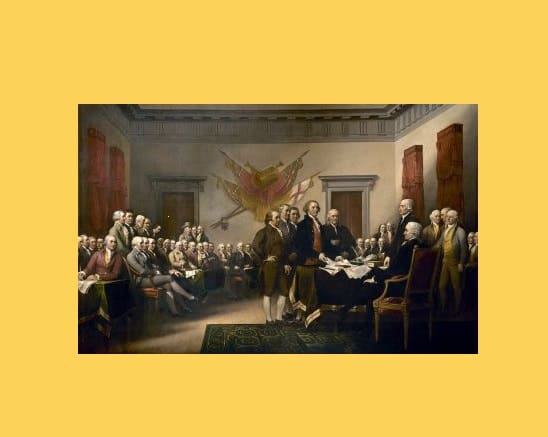
If you look at Trumbull’s famous painting of the American Declaration of Independence in 1776, you can see the Committee of Five at the front, presenting their draft version. If, however, you study the men seated on the right side, you will find the only active pastor there: Revd Dr John Witherspoon (1723-1794) from Scotland. Brought up in Yester, and receiving his schooling in Haddington, Witherspoon went on to study divinity at the University of Edinburgh, and received his honorary doctorate from the University of St Andrews.
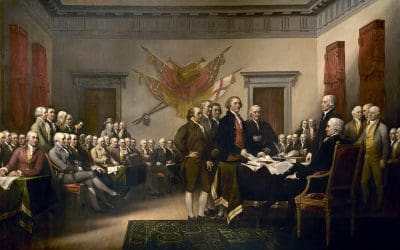
Image: The Declaration of Independence, by John Trumbull (1818), Wikipedia Commons
Following a pastorate in Paisley between 1758 and 1768, he was implored by his evangelical Christian friend Benjamin Rush, to take up residency in America, as president of a Presbyterian college, later known as Princeton University. At this evangelical college he exercised enormous influence on America, with 37 of his students becoming judges; 10 becoming cabinet officers; 12 becoming members of the Continental Congress; 28 becoming Senators; and 49 becoming US Congressman. Witherspoon’s bloodline included John Welsh, one of the leading Covenanters in the Scottish struggles of the 17th century, and he was fervent in his belief that America should be free from the control of Great Britain. Witherspoon became one of the key movers for American independence among the people. The Presbyterians had suffered heavily under the tyrannical rule of monarchs during the Covenanting times, and when many Presbyterians and Puritans fled to the colonies, they took with them their Christian faith and their longings for a Christian-based democratic government. They saw the possibility of a fresh start in America, free from religious and political tyranny.
Under Witherspoon, Princeton became a fertile meeting place of two streams: evangelical fervour and Enlightenment modernising ideas, both of which had flowed together through him and his friends in Edinburgh. Here Witherspoon could combine his evangelical zeal with the Scottish philosophers, Revd Thomas Reid’s Common Sense Philosophy, and with Revd Francis Hutcheson’s Polite Society, which sought the happiness of mankind. Indeed, Witherspoon went about using his own Edinburgh University education as a template for Princeton.
With passion and clarity, he called for a new day in America. ‘I am satisfied,’ he said, ‘that the confederacy of the colonies has not been the effect of pride, resentment, or sedition, but of a deep and general conviction that our civil and religious liberties, and consequently in a great measure the temporal and eternal happiness of us and our posterity, depended on the issue.’ Arthur Herman, a professor of history in America, has put it aptly: ‘Horace Walpole, son of the former prime minister, rose in Parliament to speak. “There is no use crying about it,” he said. “Cousin America has run off with a Presbyterian parson, and that is the end of it.” Everyone knew what he meant.’ When the Continental Congress met to sign the 1776 Declaration of Independence, about a third of the fifty-six signatories were of Ulster-Scots and Scottish Presbyterian heritage. This same influence could also be found in the producing of the American Bill of Rights in 1789, harking back to the English Bill of Rights and Scottish Claim of Rights, which had emerged out of the Covenanters’ struggle for freedom of conscience.
Both in Scotland and in America, Witherspoon was an outspoken evangelical preacher who called people back to repentance and faith in Christ. He wrote in his satire of the Moderate, or liberal pastor:
1. All his subjects must be confined to social duties – as opposed to religious doctrines.
2. There must be no reference to an afterlife.
3. His authorities must be drawn from pagan writers, and none, or as few as possible, from Holy Scripture.
4. He must be very unacceptable to the common people.
On the other hand, his good friend from Edinburgh, Revd Dr John Erskine, made sure that a constant supply of solid biblical Christian books was shipped to Princeton and many other American universities, for the purpose of nurturing generations of gospel preachers there.
‘… having been justified by His grace, we should become heirs according to the hope of eternal life… those who have believed in God should be careful to maintain good works’ (Titus 3:7-8, NKJV).
[All blogs on our website are the personal view of the writer and do not necessarily represent a position taken by CVE Scotland]