
SU Scotland ASN Ministry
This is the first blog from our Spring 2025 Newsletter theme on Additional Support Needs (ASN)
SU Scotland’s vision is to see EVERY child and young person in Scotland exploring the Bible and responding to the significance of Jesus. How do we do that effectively? If a young person struggles to concentrate, sit still, read or meet any of the other expectations placed upon them by the way we choose to explore the Bible?
It is so important to be inclusive and break down the barriers that prevent children and young people from engaging. Elaine Tait was appointed as SU Scotland’s first ASN Development Coordinator last April to enable us all journey together and learn to do this better. We were also delighted to have Elaine join as a Trustee and member of the CVE Scotland Management Committee in November 2024.
Latest statistics are that 40% of young people in Scotland currently have a noted additional support need (ASN).1 Whether teachers, chaplains or volunteers are leading an SU group, taking a class or addressing an assembly we should assume that there will be young people who are dyslexic, autistic, have ADHD or are neurodivergent in another way. We should assume that there will be young people who have a physical disability, either permanent or temporary, perhaps deaf, visually impaired or a wheelchair user. We should assume there will be young people who have additional needs through life experiences such as poverty, trauma, anxiety, bereavement, being care-experienced, a refugee or asylum seeker, or affected by a family member in prison.
As Christian teachers, chaplains and volunteers, we want every child to know that Jesus loves them and that we care. So how do we ensure that whether sharing a Bible story or playing games, what we share can be accessed by ALL?
Ideas about best practice – ALL
Accept them as they are
Listen
Link with what they love
Many young people with ASN feel they have to pretend to be something they’re not to fit in. One of the most precious gifts we can give is to accept them as they are. Each and every one of us and them is made in the image of God, fearfully and wonderfully made. What presents as challenging behaviour, could be a buildup of frustration and depletion of energy, maybe through a lack of breakfast that morning. It can be exhausting being in school or church with so many people. If a young person struggles with reading and listening, that too is exhausting. But, creating an environment where the young person knows they are accepted and that we will take time to listen to how they really are, non-verbally communicates God’s love powerfully. Linking with what they love enables them to connect with us and with the message. Jesus told parables to help his audience learn, using seeds, sheep and flowers as a means to help people understand. Could we do the same for the young people we meet? Could we share a story of a lost phone alongside the parable of the lost coin?
There are also some “easy wins” that we can include in our practice to enable everyone to belong.
- If you show a video, always have subtitles on. This will mean so much to a deaf child and will not affect the enjoyment of the hearing child.
- If using a handout, use cream or pastel coloured paper. 30% of people in the UK2 are affected by visual stress which means that black text on white paper can be very difficult to read.
- If you read a passage with a group, ask for volunteers to read. Simply saying “We’ll all take turns and read a verse” can cause anxiety for those who find reading difficult, English is not their first language or are dyslexic.
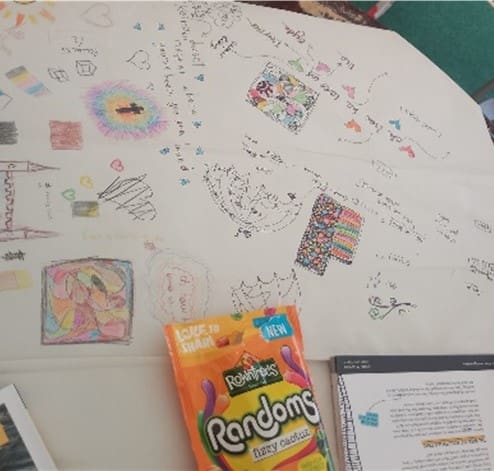
- Since some young people really benefit from doodling, let’s make that accessible to everyone. Studies have shown that people who doodle while listening remember about 29% more than those who don’t doodle.3
- Rather than asking who needs a fidget to concentrate, simply offer a little popper fidget to everyone. Consider how often we might twiddle a pen or play with our hair. We all fidget from time to time, requiring that sensory input so offering it to everyone takes out the anxiety of “Do I need it? I’m not sure.”
- Translation where English is not a young person’s first language is essential. A useful website for translating text into a variety of languages is Diffit. It’s quick and easy to use and the appreciation for the thoughtfulness and effort means so much to that young person.
- Be visual and keep the language simple. Symbols and images are so helpful for everyone, especially when English is not a young person’s first language, and they help maintain concentration.
- Sitting for prolonged periods can be difficult for many people and so including movement breaks is really helpful. Story trails such as those in Scottish Bible Society’s 10 Must Know Bible Stories enable movement breaks to be a part of the learning so there is no need to “settle” for a teaching time. https://www.scottishbiblesociety.org/shop/schools
Differentiation of resources
It can be so difficult to ensure that the resources we use are suitable for all abilities and meet all the needs that young people have. One way of dealing with this is to offer a choice of activities. The same teaching point can be learned through an individual or a paired or group activity. The same teaching point could be experienced through Lego, crafts, discussion, or music and not everyone has to do everything together. Having interest areas where young people choose for themselves how they will engage with the Bible will give opportunity for them to connect with God’s word where they are at in their journey of faith; to engage in a way that is meaningful for them.
If you would like to dig a little deeper, these website links may be of use to you.
1 Coalition calls for greater support as the number of pupils with additional support needs reaches a record high – Scottish Children’s Services Coalition
Pupil demographics in Classes and pupils – Summary statistics for schools in Scotland 2024 – gov.scot
2 Coloured Overlays and Visual Dyslexia (crossboweducation.com)
3 Why is doodling art important to kids? – Quickdraw (quickdrawart.com)
About the author
Elaine was a mainstream secondary RME teacher for 10 years before coming into post with SU Scotland and knows very well how difficult it is to deliver a BGE lesson at Level 3 while also preparing and delivering meaningful teaching and learning for pupils whose literacy level is second, first and early and all are in the one class. Thus, in the not-too-distant future, SU Scotland are planning to launch two resources. One unit comprising of 7 RME lessons for ASN schools and a Level 3 Christianity unit for RME, fully differentiated across levels. Look out for these resources soon!
If you would like help with anything in relation to ASN please do get in touch with Elaine at elaine.tait@suscotland.org.uk. She would love to hear from you!
[All blogs on our website are the personal view of the writer and do not necessarily represent a position taken by CVE Scotland]