
Churches Field Trip
Most schools organise a range of field trips for pupils. All field trips must:
- Significantly support learning
- Be practical to organise, and carefully risk-assessed
- Be attractive and motivational for the pupils (while all pupils like a day or part of a day outside the school building, they quickly lose focus if the trip is not very carefully organised, paced and structured)
If a field trip can deliver all this and the destination is fairly close to the school, so much the better! As a result, a field trip to a church can be attractive, if it is carefully planned by the church and teachers working closely together. Make no mistake, it certainly needs to offer much more than a trek round an empty building!
Churches Field Trip
While this example is drawn from a secondary school, it may readily be adapted for use by primary schools.
Schools place considerable emphasis on challenging stereotypes within the context of Inclusion and Anti-Discrimination. As part of a wider programme, the RME Department of a large secondary school organises an annual field trip to 3 churches in the Dundee area which are likely to challenge pupils’ stereotypes in relation to churches and organised Christianity. The field trip is the culmination of a topic which includes, as one of its activities researching the websites of the churches that will be visited.
 Various local churches have been visited over the years that this programme has operated. They have included:
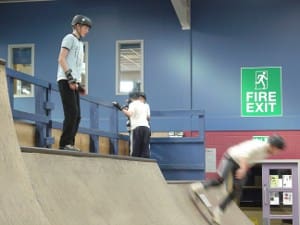
- An indoor Skateboard Park, set up and operated by a church which also meets on the premises. The enterprise has numerous activities, including work with underachieving young people, and a development project in East Africa. The building also provides accommodation for the local MSP and other agencies. Careful discussion with the organisers ensures that pupils are taken on a guided tour in small groups, during which the various exciting aspects of the work are explained. Pupils are also able to sample the Skatepark itself for a brief period (subject to parental permission!)
- An independent church which is also the headquarters of a Christian international development organisation. The visit here gives pupils the opportunity to learn about the often-close links between churches and development, the role of volunteers, etc. Since groups of senior pupils have twice gone on overseas development trips with this agency, the visit gains additional relevance.
- On different occasions, two churches (one Roman Catholic church and one Free Church of Scotland) which may have traditional buildings but whose clergy have unconventional backgrounds or ministries and who are superb – and very humorous – communicators with young people.
- A youth-oriented church that uses modern styles of worship, digital projectors/plasma screens, a band, etc. While clearly the pupils cannot witness Sunday worship, the church has produced a tightly edited DVD presentation of its work. The Youth Pastor discusses aspects of the church and answers numerous questions (the baptistry always provokes particularly lively discussion). The visit and the field trip finishes with a light lunch provided free of charge by the church. This gives further opportunities for discussion. The pupils are always particularly struck that the lunch is free and are intuitively aware of the Christian values behind this.
Other opportunities
Learning from field trips to churches is greatly increased when pupils
- Research and prepare thoroughly in advance (including preparing questions that can be thought through and debated in class)
- Engage with Clergy and church members during the visit, with plenty of opportunity for discussion (in some cases, churches have been able to organise a team of members, who have been well prepared in advance, and can engage in structured discussion with small groups of pupils during the visit)
- Understand that specific Outcomes will be overtaken by the visit (e.g. for Level 4 or Senior Phase, an investigation of community work undertaken by churches contrasted with similar activities by the public sector)
- Reflect on their visits and prepare reports on their experience. These can be simply written reports or can use digital cameras linked to PowerPoint presentations. Self- and peer-assessment should clearly be part of this.
- Pupils should also contribute in depth to the evaluation of a visit, with a focus on its value as a learning experience, rather than simply enjoyment.
For other examples of how church visits can support learning, see https://www.syls.org.uk/simple-ideas/a-church-visit.html
Another case study from the Serve Your Local School site shows how visits by pupils to a local church can be part of a wide-ranging educational programme: https://www.syls.org.uk/stories/easterhouse-baptist-church.html