
RSHP in schools in 2023
What is happening in Relationships, Sexual Health & Parenthood (RSHP) in schools in 2023?
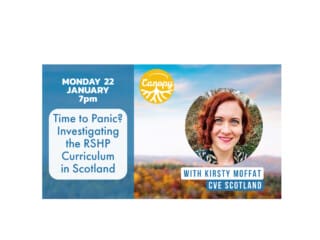
Kirsty Moffat, the CVE Scotland RSHP Project Leader writes:
We seem to be living in a time of public outrage and division. I say ‘seem to be’ because it can sometimes be hard to tell how much of the virtual outrage I am exposed to through social media is really reflective of the average person, and how much is extreme views highlighted by algorithms that want me to keep reading and clicking. Some Christians who hold to the historical Christian view on issues of sexuality and gender may feel that they, and their beliefs and values, are under attack.
When we see this, it’s difficult not to worry about the children and young people we care about. What are they being exposed to? What is happening in schools? Some reports on Relationships and Sex Education (RSE) in England point towards the indoctrination of young people in schools where debated ideologies are promoted as fact, while others believe the curriculum is grooming and sexualising children.
In Scotland, it is likely that the majority of schools will be using the RSHP.Scot resources. These are accessible to view online, which enables us to get an idea of the content in Scottish classrooms. It ranges from fairly innocuous lessons about friendship and online safety, to problematic lessons that promote masturbation. Throughout, there is an underlying secular worldview, including values like individualism and self-expression, and secular concepts of identity. This is why we are producing supplementary and replacement materials that address these issues.
However, as is not mandatory to use the RSHP.Scot resources, there is still the possibility of schools producing their own materials or using external providers that expand further on controversial topics. That being said, schools and external providers are required to follow governmental guidance on the teaching of RSHP, so it is worth looking at this guidance and its implications.
The Scottish Government has recently published new draft guidance for teaching RSHP, which replaces the 2014 guidance. They have also opened a public ‘Consultation on draft Statutory Guidance on the Delivery of Relationships, Sexual Health and Parenthood (RSHP) Education in Scottish Schools’, which members of the public can respond to, by November 23rd, 2023. We would encourage you to respond to the consultation, as individuals, churches or other organisations, as it is an important document with broad implications.
Firstly, as I have already pointed out, schools and external providers need to comply with the guidance. This gives parents and carers the ability to question or challenge resources that are inconsistent with its advice. This also has implications for external organisations with a Christian character or viewpoint, as they too must ensure that any RSHP work they do in schools follows the guidance. Secondly, it explains the rights of parents and the process of withdrawal from sexuality education, as well as the expectation that parents will be informed of RSHP lesson content. Finally, it broadly lays out the purpose of RSHP education, which has implications for our children and young people.
The guidance itself is remarkably long, and not very accessible for those who do not have experience in Scottish education policy. In order to equip people to respond to the consultation, I have produced several documents to help people navigate the guidance and respond to the consultation.
For those pressed for time, it may be beneficial to read the Guidance Summary to get the gist of what the guidance says, and then focus on particular sections of interest in the guidance itself. This could be read alongside a summarised version of CVE Scotland’s response to the consultation, if you would like an idea of possible responses. Most of the consultation questions ask about the clarity of the guidance, so if there are sections of the guidance that you don’t understand, you should make this clear in your response. I have also produced a summary of the key themes with a more detailed discussion of questions and concerns raised by the guidance.
At the end of the day, it’s also important to remember that school is not the only place our children and young people will be learning about relationships and sexuality. Parents and churches have an important part to play, and we need to seriously consider how to disciple young people in this area (which could be a whole other blog post). We will highlight some resources to help support you with this.
I want to leave you with Paul’s encouragement to the church in Philippi (Philippians 4:4-7 ESV), to ‘Rejoice in the Lord always; again I will say, rejoice. Let your reasonableness be known to everyone. The Lord is at hand; do not be anxious about anything, but in everything by prayer and supplication with thanksgiving let your requests be made known to God. And the peace of God, which surpasses all understanding, will guard your hearts and your minds in Christ Jesus.’ I pray that when that flame of outrage flickers and ignites a reaction of fear and anxiety, we will bring it before God in prayer, and allow His peace to carry us through.
[All blogs on our website are the personal view of the writer and do not necessarily represent a position taken by CVE Scotland.]